
Beautiful Plants For Your Interior

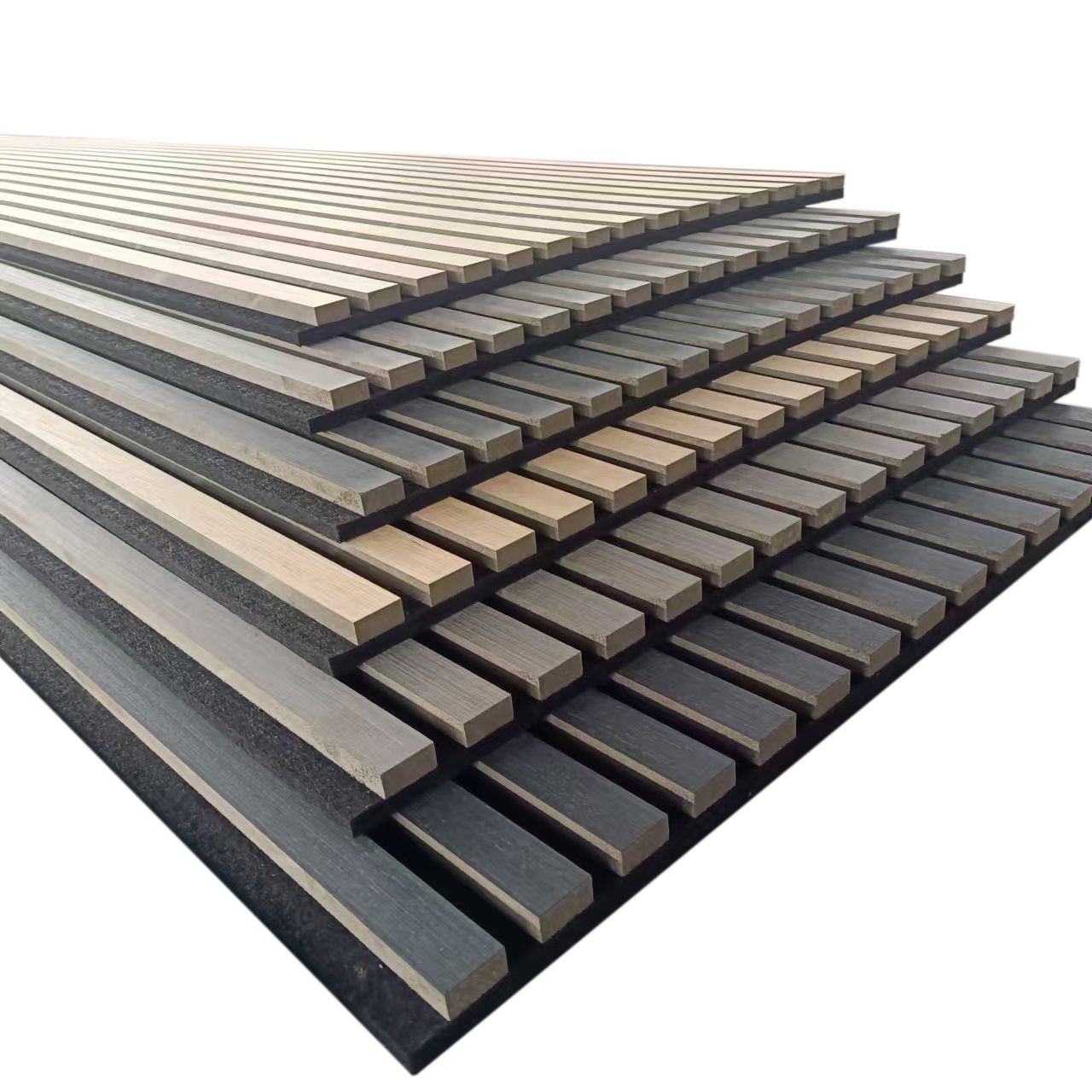
Polyester fiber acoustic panels have become one of the commonly used sound-absorbing materials in the modern acoustic design industry. Wood acoustic panels are comparable to and competitive with polyester fiber acoustic panels. Traditional Chinese thought and practice have proven that wood-based home building materials are essential in modern homes, and are generally more expensive and used more frequently than other materials. Polyester fiber acoustic panels, on the other hand, have become a popular sound-absorbing material in recent years. After extensive use and testing, they have been widely accepted and have become a leading sound-absorbing material in the modern sound-absorbing industry.
Wooden acoustic panels: Grades are differentiated by strip structure and surface material. Standard products have a melamine finish, with strips measuring 2440mm x 138mm x 15mm, and thicknesses of 12mm, 15mm, and 18mm. High-end products have a wood veneer finish, with strips measuring 13mm x 3mm x 15mm. Non-standard sizes can also be customized upon request. Advantages: Grooved and perforated, novel, stylish, and aesthetically pleasing.Polyester fiber acoustic panels: 122024209mm, large panel size, available in smooth, textured, and printed finishes. Advantages: Can be cut by hand, and can be patterned.
Wooden acoustic panels come in a rich variety of colors, with over ten solid colors and more than 160 wood grain colors. Polyester fiber acoustic panels have slightly fewer colors compared to wooden acoustic panels, with approximately 40 solid colors. Wooden acoustic panels are heavier, while polyester fiber acoustic panels are lighter.
With a 5cm gap left at the back during construction and filled with sound-absorbing cotton, at 1000 Hz, the sound absorption coefficient of the polyester fiber sound-absorbing board (9mm thick) is 1.00, while that of the wooden sound-absorbing board is 0.88. It can be seen that the sound absorption performance of the polyester fiber sound-absorbing board is better than that of the wooden sound-absorbing board.
Compared to other sound-absorbing materials, polyester fiber acoustic panels are more suitable for modern homes. They combine the decorative properties of acoustic upholstery with the sound-absorbing capabilities of acoustic panels, making them a hybrid of upholstery and solid materials. Compared to traditional sound-absorbing materials, they offer several advantages.
Similar to the sound absorption characteristics of other porous materials, the sound absorption coefficient of polyester fiber sound-absorbing panels increases with increasing sound frequency, with a high absorption coefficient at high frequencies. Within the noise range of 125-4000Hz, the absorption coefficient reaches greater than 0.8, effectively removing sound impurities, improving sound quality, and enhancing speech clarity. Spatial sound absorbers further enhance the material’s sound absorption performance, making them highly efficient sound absorbers with a wide frequency range. They are widely used in theaters, concert halls, indoor gyms, conference rooms, HV theaters, hotels, home theaters, and other venues with high acoustic requirements.
No sound-absorbing cotton, decorative panels, or even auxiliary materials are needed. Simple operations such as gluing, drilling, planing, and ruthenium filing can achieve desired sound absorption and decorative effects, reducing overall project costs and construction time.
Polyester fiber acoustic panels are made from a fiber similar to clothing, possessing inherent heat insulation properties. Once formed into panels, they also exhibit elasticity, resilience, abrasion resistance, impact resistance, tear resistance, scratch resistance, and large panel sizes (2420 inm x 1220 inm; 2440 mm x 1220 mm).

Hey guys, just found royalbetaffiliates and it’s looking pretty sweet! Definitely checking it out. Hope it lives up to the hype! Worth a peek – royalbetaffiliates